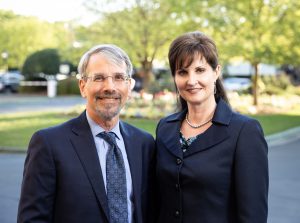
Center co-directors David Ardia and Amanda Reid
The UNC Center for Media Law and Policy is an interdisciplinary research center run jointly out of the UNC School of Law and UNC Hussman School of Journalism and Media. The Center’s work ranges from the legal and policy issues affecting traditional media organizations to the challenges posed by new communication technologies, including social media and artificial intelligence, and the impact they are having on governments, on the economy, and on cultural and social values throughout the world.
The mission of the Center is threefold: (1) to provide a forum for study and debate about important media law and policy issues; (2) to have an impact on these issues by supporting the development of legal and policy initiatives that help the traditional and new media meet the information needs of all Americans; and (3) to help educate the next generation of media lawyers, journalists, media executives, entrepreneurs, and policymakers who will continue to grapple with these challenging issues.
The Center capitalizes on the extraordinary strengths of UNC-Chapel Hill’s highly regarded law and journalism schools. Center events and projects bring together a diverse group of legal and communication scholars, media professionals, and practicing attorneys. Faculty and graduate students affiliated with the center conduct media law and policy research, host public events, including UNC’s annual First Amendment Day, and work to identify legal and policy interventions that address the deteriorating health of our public sphere and that support the creation and dissemination of information that meets the needs of American democracy.
History
The Center was conceived by attorney Wade Hargrove and the deans of the School of Law and School of Journalism and Media, who together decided the University of North Carolina at Chapel Hill would be the ideal home for a media law and policy center. A graduate of UNC-CH and the UNC School of Law, Hargrove is a former partner with Brooks, Pierce, McLendon, Humphrey & Leonard where his practice was concentrated in media, telecommunications, Internet, antitrust, corporate, and copyright law. Hargrove also served as chair of the UNC-CH Board of Trustees from 2011–13. Hargrove helped the Center obtain its first funding from the Hearst Foundations and has been instrumental in the Center’s success.
In 2009, Dean Jean Folkerts appointed Dr. Cathy Packer, then the W. Horace Carter Distinguished Professor in the UNC School of Journalism and Media, to serve as the Center’s first faculty director. In 2011, Dean Jack Boger appointed Professor David Ardia, Reef C. Ivey II Excellence Fund Term Professor of Law at the UNC School of Law, as the Center’s first co-director from the law school. Upon Packer’s retirement in 2017, Dr. Michael Hoefges served as the Center’s interim co-director for one year. From 2018–20, Dr. Victoria Smith Ekstrand served as the Center’s co-director from the journalism school. In 2021, Dean Raul Reiss appointed Dr. Amanda Reid, associate professor at the UNC Hussman School of Journalism and Media, as co-director. The Center’s current faculty co-directors are Prof. Ardia and Dr. Reid.
Recent Events and Projects
The Center and its affiliated faculty have published important research on a wide array of media law and policy issues. The Center also sponsors and supports the First Amendment Law Review, a student-edited law journal that publishes articles by academics, law students, and industry professionals, and it administers UNC’s two dual-degree programs (J.D./M.A. and J.D./Ph.D.) in Law, Media and Communication that prepare students to be leaders in the fields of media law and media policy. In addition, the Center organizes a number of events and workshops each year. Some recent highlights include:
| First Amendment Day–The center organizes UNC’s annual campus-wide, day-long event to celebrate the First Amendment and explore its role in the lives of Carolina students. Students and university staff read from banned books, sing controversial music, and discuss the importance of each of the rights protected by the First Amendment, the need to be tolerant when others exercise their rights, and a public university’s special role as a marketplace of ideas. This event is truly one of the highlights of the year for the UNC community. | Workshops, Panels and Policy Initiatives-The center brings together lawyers, social scientists, computer and information scientists, communication scholars, government officials, and legal academics to discuss the most pressing media law and policy issues facing North Carolina, the nation, and the world. These interdisciplinary conversations have addressed such topics as the FCC’s media ownership rules; support for local accountability journalism; online piracy; shield laws; and the effects of technological change on society. |
| Interdisciplinary Faculty Lunches-The center hosts monthly lunches for faculty and graduate students from across the UNC system to discuss media law and policy issues. Past topics have included: the legacy of Justice Antonin Scalia; web accessibility and the Americans With Disabilities Act; provocative art and the boundaries of free expression; technologies of democracy; measuring online engagement; privacy by design; ownership of research data; patterns of information sharing in social networks; big data and computational politics; the right to be forgotten; and social networks, privacy, and politics. | Public Speakers and Colloquia-The center hosts internationally renowned speakers. Past speakers have included: David Barrett, chairman and CEO of Hearst Television Inc.; Ben Sherwood, president of ABC News; Lawrence Lessig, Furman Professor of Law and Leadership at Harvard Law School; Sir Christopher Meyer, former British ambassador to the U.S. and chair of the U.K.’s Press Complaints Commission; Kevin Martin, former FCC chairman; Ken Paulson, president and CEO of the First Amendment Center; and Noam Chomsky, political commentator and philosopher. |
| Media Law and First Amendment Symposia–The center sponsors several law review symposia each year, partnering with the North Carolina Law Review, First Amendment Law Review, and NC Journal of Law and Technology. Recent topics have included: Net Neutrality and First Amendment issues in Internet regulation; the impact of the Supreme Court’s decision in New York Times v. Sullivan; student speech rights; social networks and the law; government surveillance; and campaign finance. | Law School for Digital Journalists–Each year, the center partners with the Online News Association to present a “law school for digital journalists.” This practical legal training covers such topics as copyright law, newsgathering, libel, privacy, access law, and forming and running a news business. The first year’s classes were held at Harvard Law School. In subsequent years, the sessions have been held at ONA’s annual conference in San Francisco, Atlanta, and Chicago. |