Tag Archives | Hargrove Colloquium

2026 Hargrove Colloquium–The Regulator’s Dilemma: Innovation and Global Competition

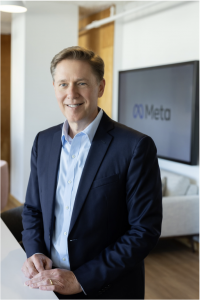
On April 6, the UNC Center for Media Law and Policy will host the 2026 Hargrove Media Law and Policy Colloquium, featuring Kevin Martin, vice president and head of global policy at Meta and former chairman of the Federal Communications Commission. Titled The Regulator’s Dilemma: Innovation and Global Competition, the event will explore how regulators and industry leaders can respond to rapid technological change while fostering innovation and maintaining competitiveness in an increasingly global media and communications marketplace.

Mr. Martin brings a rare combination of senior government, private practice, and global policy experience to this conversation. He served two terms as commissioner and chairman of the FCC during a period of significant transformation in telecommunications, broadband, and media regulation. Before joining the FCC, he worked at the White House as a Special Assistant to the President for Economic Policy and as a member of the National Economic Council staff, where he focused on commerce and technology policy. He also represented the United States on the G‑8 Digital Opportunity Task Force, addressing how the digital revolution could expand opportunity in developing countries. After leaving government service, Mr. Martin was a partner and co-chair of the telecommunications practice at an international law firm before joining Meta, where he now leads global engagement with policymakers on privacy, connectivity, trade, and related issues.

In addition to delivering prepared remarks, Mr. Martin will sit down for a conversation with Julia Ambrose, who clerked for Associate Justice Sandra Day O’Connor and now leads the media law practice at Brooks, Pierce, McLendon, Humphrey & Leonard, LLP. Their discussion will examine the practical and philosophical tensions between regulation and innovation, the growing importance of international policy considerations, and the role lawyers play in advising clients amid regulatory uncertainty and global competition.

Designed for lawyers, media and technology industry leaders, policymakers, and students, the evening will offer a thoughtful and timely examination of the regulatory choices shaping the future of media and communications. The event will also highlight the enduring relevance of media law and policy education at a moment when regulatory decisions increasingly influence innovation, democratic values, and economic growth worldwide.

The colloquium will take place on April 6 at 7:00 p.m. at the Paul J. Rizzo Conference Center, 130 DuBose Home Lane, Chapel Hill, NC 27517. The event is free and open to the public, though advance registration is encouraged due to limited seating. Registration is available here.

For more information on the Colloquium, please visit our event page.
0

2024 Hargrove Colloquium: Media Law in the Age of Artificial Intelligence

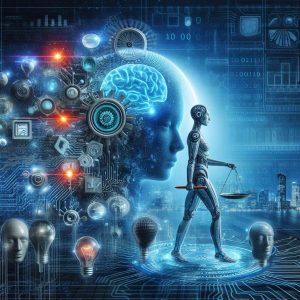
Generated by AI with Copilot Designer

On April 16, 2024, the Center for Media Law and Policy will be hosting the 2024 Hargrove Colloquium.  The topic for this year’s colloquium is Media Law in the Age of Artificial Intelligence. Come hear from David McCraw, deputy general counsel at The New York Times Co. and author of the book Truth in Our Times: Inside the Fight for Press Freedom in the Age of Alternative Facts, as well as Ruth Okediji from Harvard Law School, who served as a member of the National Academies’ Board on Science, Technology and Policy Committee on the Impact of Copyright Policy on Innovation in the Digital Era.

Our distinguished panel of experts will examine efforts at the federal and state level to prevent potential abuse of AI and will delve into the impact of generative AI on critical areas of media law, offering insights and sparking thought-provoking discussion. Key areas of focus will include:

  • Copyright Law: Who owns the creative output generated by AI? What is the impact on copyright holders when their work is used in training AI systems? How will existing copyright frameworks adapt to accommodate generative AI?
  • Defamation and Tort Law: Who, if anyone, can be held liable for harmful or defamatory content that AI generates? What are the legal implications for users and platforms employing AI-powered algorithms to curate and publish information?
  • Political Communication: How is AI being used in political campaigns and advertising? What are the potential risks and safeguards around AI-powered misinformation and voter manipulation?
  • Journalism: How is AI transforming the news industry? What are the legal and ethical considerations surrounding AI-generated news? How can journalists leverage AI while upholding journalistic integrity?

The Colloquium will take place at 7:00 PM at the George Watts Hill Alumni Center at the University of North Carolina and is free and open to the public. Visitor parking is available in the Rams Head Parking Deck.

You can read more about the colloquium on our event page.

0

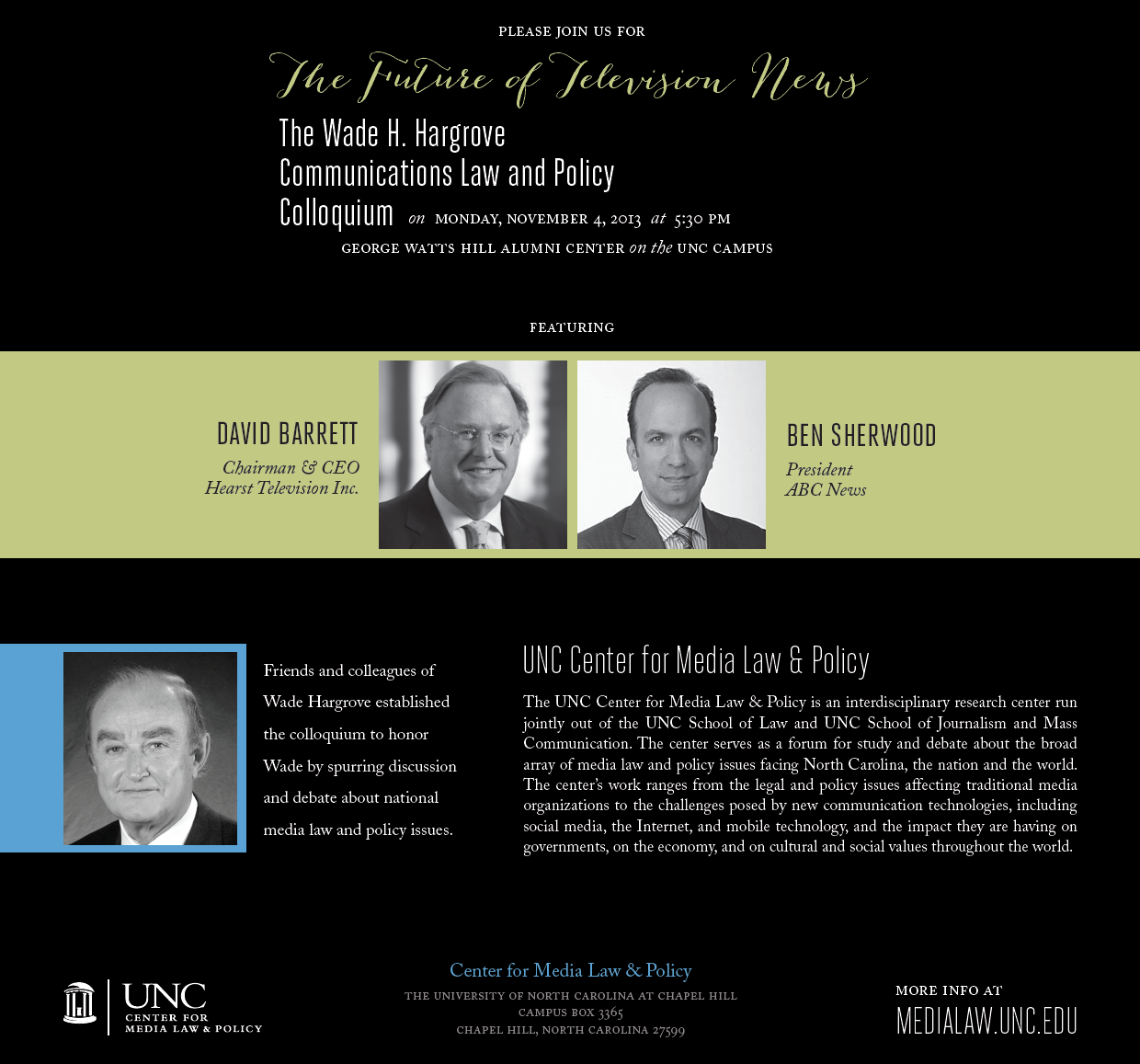
Hearst TV CEO and ABC News President to Headline Inaugural Hargrove Communications Law Colloquium

Hargrove ColloquiumWe are pleased to announce that on November 4, 2013, the Center will host the inaugural Wade H. Hargrove Communications Law and Policy Colloquium. Friends and colleagues of Wade Hargrove established the colloquium to honor Mr. Hargrove, a graduate of the University of North Carolina at Chapel Hill and an accomplished media lawyer, by spurring discussion and debate about national media law and policy issues.

This year’s colloquium speakers will be David Barrett, chairman and CEO of Hearst Television Inc., and Ben Sherwood, president of ABC News, who will talk about “The Future of Television News.”  Mr. Barrett and Mr. Sherwood will make brief opening remarks and then engage in a wide-ranging discussion about the challenges and opportunities media companies face in this age of digital convergence.

The colloquium  is free and open to the public.  For more information, please visit our event page.

About David Barrett
David Barrett joined Hearst in 1984 as general manager of the company’s Baltimore radio stations, later assuming general manager responsibility for the Hearst Radio Group, and then for WBAL-TV in Baltimore. He relocated to New York in 1991 as a vice president of Hearst Corporation and deputy general manager of Broadcasting, with operating oversight for the company’s television and radio stations. In 1997, Hearst Broadcasting merged with Argyle Television to form Hearst-Argyle Television, Inc., and he was named executive vice president and chief operating officer of the new entity. He was named president and chief executive officer in 2001.

Mr. Barrett has been the recipient of numerous industry honors. In 2011 he received the DiGamma Kappa Distinguished Achievement Award in Broadcasting from the University of Georgia’s Grady College of Journalism, which bestows the annual Peabody Awards, and the First Amendment Leadership Award from The Radio Television Digital News Foundation. In 2008 he was inducted into the Broadcasting & Cable Hall of Fame. In 2005 he was the recipient of The Media Institute’s American Horizon Award and was also inducted into the National Academy of Television Arts and Sciences Management Hall of Fame. In 2004 he was named Broadcasting & Cable magazine’s “Broadcaster of the Year.”

About Ben Sherwood
Ben Sherwood was named president of ABC News in December 2010. He is responsible for all aspects of ABC News’ broadcasts, including “World News with Diane Sawyer,” “Nightline,” “Good Morning America,” “20/20” and “This Week with George Stephanopoulos.” In addition, Mr. Sherwood oversees ABC News Radio, ABCNEWS.com, satellite service NewsOne and ABC News NOW. During Mr. Sherwood’s tenure the news division has won the most prestigious honors in the industry, including George Polk, George Foster Peabody, News and Documentary Emmy, Edward R. Murrow, Overseas Press Club, SPJ Sigma Delta Chi and Investigative Reporters and Editors awards.

A Phi Beta Kappa graduate of Harvard College, Mr. Sherwood earned a bachelor’s degree in American government and history. From 1986 to 1989, as a Rhodes Scholar at Magdalen College, Oxford, he earned master’s degrees in British imperial history and development economics.

0