States enact social media privacy laws protecting employees, students

In August, New Jersey became the twelfth state to pass a law prohibiting employers from asking employees for their social media usernames and passwords. Read more about the New Jersey law here.

Some states, including California, Michigan, and Illinois, also prohibit schools from requiring students to disclose their social media passwords. Illinois’s Right to Privacy in the School Setting Act takes effect January 1, 2014.

0

A UNC Student’s Summer Experience at NPR

IMG_0046
I have always admired NPR’s style of broadcast journalism. Through their use of compelling voice-overs, descriptive writing styles, and natural sound, the organization’s reporters have a way of bringing life to stories that lack pictures. Naturally, as one of UNC’s law and journalism dual-degree students, I jumped at the opportunity to spend my summer working in NPR’s Office of the General Counsel.

At NPR, I received exposure to all aspects of media law. On a typical day, I could do anything from answering fair use questions to investigating international broadcasting issues to assisting with FOIA requests. By working at NPR, my knowledge of First Amendment, intellectual property, and administrative law increased immeasurably.

The staff at the OGC also encouraged me to attend legal events outside NPR. I heard Gary Pruitt, Chairman and CEO of the Associated Press, speak at the National Press Club about the Department of Justice’s decision to subpoena, without notice, phone records from the AP’s reporters. I also interacted with prominent members of the media law community at events held at The Washington Post and other venues around D.C. My days were rarely, if ever, filled with a dull moment.

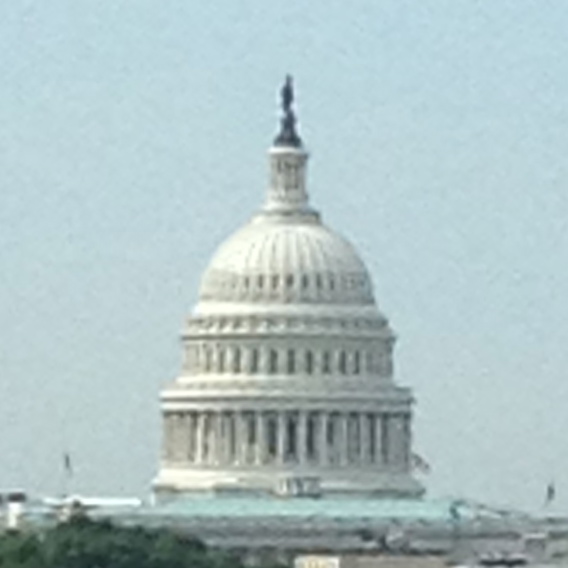
I had the added benefit of working in NPR’s brand-new building located at 1111 North Capitol Street, NE. From my office desk, I had this amazing view of the Capitol Building.

IMG_0045

Being located at NPR’s new headquarters also enabled me to interact with members of the newsroom and watch broadcasts of Morning Edition, All Things Considered, and Talk of the Nation.

Through these activities, I left the classroom setting and observed how media law issues impact real journalists.

I would recommend NPR’s internship program to anyone interested in media law. The organization has many intelligent and talented people who are eager to help interns learn. I am honored to have been an intern in the OGC and am proud to have represented Carolina at NPR!

Kevin Delaney is a 2L at the University of North Carolina School of Law and a second-year master’s student at the UNC School of Journalism and Mass Communication.

0

Senate Judiciary Committee Meets to Discuss Federal Shield Law, S.987

Screen Shot 2013-09-12 at 10.09.00 AM

Natasha Duarte contributed to this post.

The Senate Judiciary Committee is scheduled to meet with lawmakers today to discuss the federal reporter shield bill proposed by Senator Schumer (D-NY) in May of this year. Tune in to a live webcast of the meeting beginning at 10:00am.

The Free Flow of Information Act, S.987, includes some protection for reporters who are ordered to divulge confidential sources as part of a federal investigation. The public push for a federal shield law has gained traction over recent months as the public reacted to governmental invasions into journalist organizations like the Associated Press.

Although the bill seems to be a positive step towards granting journalists protection, critics have noted one troublesome section of the bill that limits the definition of who constitutes a “journalist” or a “covered person.” Senator Dianne Feinstein (D-Calif.) has proposed an amendment to S.987 that would limit the classification of a journalist to a salaried agent of an organization that “disseminates news or information.”

The Electronic Frontier Foundation outlined Feinstein’s proposed amendments to the definition of ”covered person”:

  • A person working as a “salaried employee, independent contractor, or agent of an entity that disseminates news or information;”
  • either (a) meeting the prior definition “for any continuous three-month period within the two years prior to the relevant date” or (b) having “substantially contributed, as an author, editor, photographer, or producer, to a significant number of articles, stories, programs, or publications by an entity . . . within two years prior to the relevant date;” or
  • working as a student journalist “participating in a journalistic publication at an institution of higher education.”

Senator Feinstein cites a need to limit the bill’s protection from including those “who aren’t really reporters at all, who have no professional qualifications” and says she believes the bill should be applied to “real reporters.”

Critics of the proposed amendments have argued that a narrow definition of what it means to be a journalist doesn’t fit the ever-evolving model of reporting. Technological developments over the last two decades have resulted in a shift away from the traditional definition of what it means to be a “journalist.” Reporting is increasingly being done by citizen journalists, bloggers, and independent reporters who are not employed by traditional media outlets.

This model will no doubt continue to evolve along with new technology. Critics of the bill suggest that reporting is an act rather than a status and that those engaged in reporting should be protected from having to reveal their confidential sources regardless of medium, employer, or salary.

0

Amicus brief argues NSA surveillance violates freedom of the press

The Reporter’s Committee for the Freedom of the Press filed an amicus brief in ACLU v. Clapper arguing that government collection of call records violates the First Amendment freedom of the press by impeding reporters’ ability to maintain confidential sources.

The brief supports the ACLU’s motion for a preliminary injunction to stop the NSA from collecting logs of the time and duration of phone calls made within the United States. The ACLU’s complaint includes a First Amendment claim based on the freedom of association — the right to organize and express political ideas as a group — but RCFP’s brief focuses on the right of the press to gather news.

The brief argues that mass surveillance makes sources more wary of contacting journalists and emphasizes that confidential sources are critical to accurate reporting on important issues.

0

District Court Enjoins FilmOn X

filmon_logoLast Thursday, September 5, the District Court for the District of Columbia issued a preliminary injunction against FilmOn X, a for-profit company that streams broadcasters’ content—without permission—over the Internet to subscribers. The injunction prevents FilmOn X from operating in nearly every jurisdiction in the country and serves as a major setback for the company founded by billionaire Alki David. The ruling is the latest plot twist in a drama playing out between broadcasters and companies that retransmit their content over the Internet without consent.

The District Court found the preliminary injunction warranted after concluding the plaintiffs (that is, the broadcasters who initiated the suit) would be likely to succeed in their claim that FilmOn X violated their right to perform copyrighted works publicly. The ruling is in stark contrast to a nearly identical case (WNET v. Aereo, Inc.) the Court of Appeals for the Second Circuit ruled on last April. The Second Circuit held that Aereo, a company that operates a similar service to FilmOn X, transmitted “unique copies of broadcast television programs” that are sent to single users at their direction, not to the public at large. Thus, the Court of Appeals ruled that Aereo’s service does not violate the public performance right.

FilmOn X, much like Aereo, uses “minute” antennas to capture the television signals broadcasters are required by law to transmit over-the-air for free. Once captured, the company retransmits the signals over the Internet to subscribers, who have the option of watching content live or (if using the company’s DVR service) at a later time.

By devoting a dedicated antenna to each subscriber, FilmOn X contended that it sent private transmissions over the Internet and thus did not violate the public performance right. Unlike in Aereo, however, the District Court did not find the argument persuasive.

Central to the court’s ruling was its interpretation of the “transmission clause,” located in § 101 of the Copyright Act of 1976. Under the transmission clause, a work is performed “publicly” when it is transmitted “by means of any device or process, whether the members of the public capable of receiving the performance or display receive it in the same place or in separate places and at the same time or at different times.” In concluding that the transmit clause applied to FilmOn X, the court wrote:

FilmOn X transmits (i.e., communicates from mini-antenna through servers over the Internet to a user) the performance (i.e., an original over-the-air broadcast of a work copyrighted by one of the Plaintiffs) to members of the public (i.e., any person who accesses the FilmOn X service through its website or application) who receive the performance in separate places and at different times (i.e. at home at their computers or on their mobile devices). FilmOn X violates §§ 101 and 106(4) of the 1976 Act, meaning that Plaintiffs are likely to succeed on the merits of their copyright infringement claim.

Under the District Court’s ruling, FilmOn X is enjoined from operating its service in every jurisdiction excluding the Second Circuit, where the decision in Aereo serves as controlling precedent.

Many commentators believe it will ultimately be up to the Supreme Court to decide the legality of services like FilmOn X and Aereo.

We’ll keep you posted on the developments. Until then, here is the link to the District Court’s ruling.

Kevin Delaney is a 2L at the University of North Carolina School of Law and a second-year master’s student at the UNC School of Journalism and Mass Communication.
 

0