
It was a busy week at EFF. The phones have been ringing almost non-stop with journalists, supporters, and concerned people. The news outlets wanted interviews with attorneys. The supporters wanted to commiserate. The concerned people wanted answers — how can the government do this, and what does it mean? Of course, the fact that the National Security Agency has been spying on Americans’ phone records was the big story, but that’s not the only threat to our rights to privacy and free speech that we suffered this week.
Warrantless DNA searches
On Monday, the Supreme Court ruled that police can take a DNA sample from someone who is arrested — not even convicted of a crime — without a warrant. A DNA swab is a search under the Fourth Amendment, and this is the first time the Court has allowed an exception to the need for a warrant for general crime solving and investigative purposes. The majority held that the “search” was only the cheek swab to collect the DNA, not the subsequent steps of extracting the DNA profile and comparing it to an FBI database of DNA left at crime scenes.
Revenge porn
Also on Monday, new legislation passed the California State Senate’s Public Safety Committee that would make the electronic distribution of revenge porn a misdemeanor. Revenge porn is the practice of posting pictures of former romantic or sexual partners online. EFF Staff Attorney Nate Cardozo was interviewed by ABC about the bill’s First Amendment implications.

Nate being interviewed by ABC News. The interns were filmed for some B-roll, but we didn’t make the cut.
Nate said that while revenge porn is a “serious issue,” the California bill is not narrowly tailored enough to pass First Amendment scrutiny because it punishes not only the “bad actor” (the person who posts pornographic pictures) but also everyone who distributes the images once they are posted.
NSA phone and Internet data collection
On Wednesday and Thursday, The Guardian published leaks from Edward Snowden revealing that the National Security Administration has been operating a broad, untargeted phone and Internet spying regime for at least seven years. Wednesday’s leak revealed that the NSA has been collecting the phone records of millions of Verizon customers, including all calls made into, within, and out of the United States. Thursday’s leak revealed that the NSA has been intercepting certain information from major Internet companies including Google, Microsoft, Apple, Facebook, and Skype.
These leaks confirm that the government has been using secret law to justify warrantless spying on Americans. The Fourth Amendment generally protects us from warrantless, suspicionless searches by the government. The NSA derives its authority to collect phone records from secret opinions and orders from the Foreign Intelligence Surveillance Court interpreting the Patriot Act. Unlike other courts, whose opinions are public, FISA Court opinions and orders are kept secret.
Why we should care that the government is collecting our phone records
In a statement on Thursday, President Obama said we shouldn’t worry about the NSA’s data collection because the government is not listening to our phone calls. It’s true that the NSA needs to obtain a warrant, based on reasonable suspicion, to listen to the content of someone’s phone call. But even without hearing your conversation, the NSA can obtain an alarming amount of data about you based on whom you called, where you called to and from, and when the calls were made. This information is commonly referred to as “metadata,” and EFF Senior Staff Attorney Kurt Opsahl’s new blog post explains why it matters. These are some of Kurt’s examples illustrating what your phone records might reveal to the NSA:
- They know you called the suicide prevention hotline from the Golden Gate Bridge. But the topic of the call remains a secret.
- They know you spoke with an HIV testing service, then your doctor, then your health insurance company in the same hour. But they don’t know what was discussed.
- They know you received a call from the local NRA office while it was having a campaign against gun legislation, and then called your senators and congressional representatives immediately after. But the content of those calls remains safe from government intrusion.
President Obama also said that we can’t have 100 percent privacy and 100 percent security. He believes the government has struck the correct balance. He said he welcomes a national debate about how much privacy we want to give up in the name of fighting terrorism. However, he also said he does not welcome leaks about the NSA’s spying programs. How can we have a real debate about how much spying is too much, and how can the American people have a say in the so-called balance between privacy and security, when the government does all it can to hide the details of and justifications for its data collection programs?
Woody comes to California!
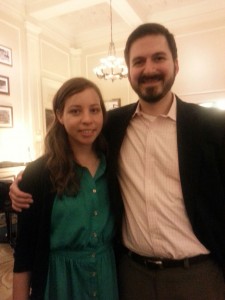
Me and Woody at a reception for the Privacy Law Scholars Conference.
Woodrow Hartzog, brilliant privacy scholar, law professor, UNC J-School alumnus (Ph.D. 2011), and the best mentor a nerd could ask for, came to town this week for the annual Privacy Law Scholars Conference. Woody presented a working paper with Daniel Solove on privacy law and the FTC. It was so great to catch up!