
This study explores the rapidly evolving landscape of state-level digital platform regulation in the United States and uncovers a surprising mathematical dimension to how overlapping laws impact technology design, compliance costs, and market dynamics.
🔍 What the Research Explores
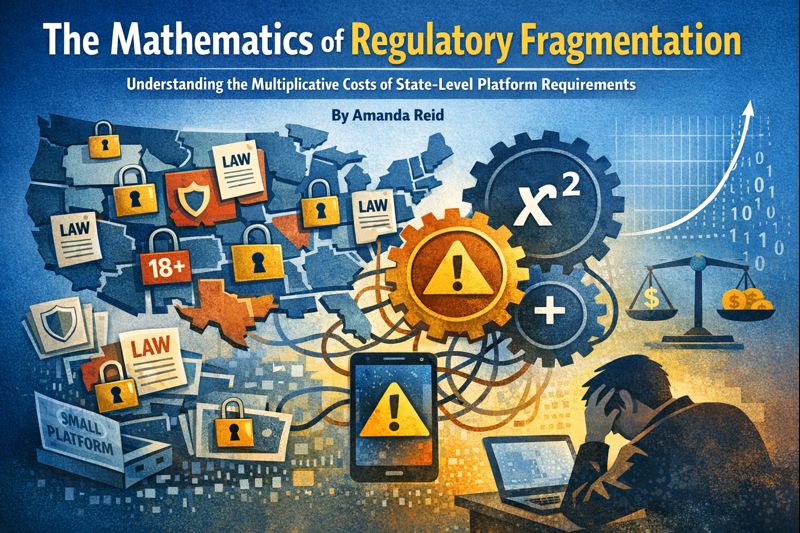
State governments have introduced a patchwork of social media safety laws that impose technical mandates on online platforms — especially aimed at enhancing user protections such as youth safety. While well-intentioned, these regulations do not simply add compliance costs as jurisdictions pile on more rules. Instead:
-
Each new state requirement interacts with every other, creating multiplicative — not additive — technical burdens for platforms.
-
This exponential growth in complexity stems from a combinatorial reality: as more distinct regulations are introduced, the number of potential conflicts and design constraints multiplies rapidly.
-
Smaller platforms and new market entrants are particularly disadvantaged, as they face disproportionately high engineering and operational costs to satisfy conflicting rules across jurisdictions.
-
Ironically, regulatory fragmentation may also undermine the very safeguards these laws are meant to provide, by incentivizing workarounds and fragmenting the user experience.
📌 Why It Matters
This research highlights a critical, often overlooked dimension of digital policy: the interactions between laws matter just as much as the content of the laws themselves. By applying mathematical reasoning to regulation, this work provides policymakers, researchers, and technologists with a new lens for assessing the real-world effects of decentralized digital governance.
The paper contributes to debates on platform regulation, digital governance, and the economics of compliance: topics that are central to recent legislative efforts across the U.S. and around the world.
📥 Read the Paper
The full paper (58 pages) is available on SSRN.
No comments yet.