
Tag Archives | Students

UNC media law student publishes in Communication Law and Policy

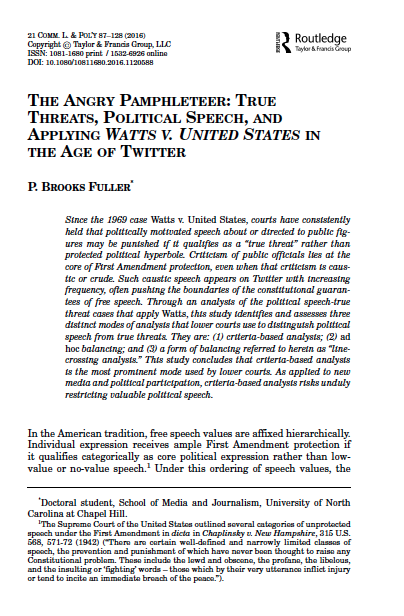
Screen Shot 2016-01-31 at 12.18.42 PMUNC media law student Brooks Fuller recently had an article published in Communication Law and Policy. The article is “The Angry Pamphleteer: True Threats, Political Speech, and Applying Watts v. United States in the Age of Twitter.”

In light of the rise of “caustic” political speech on new media, the article examines modes of analysis that lower courts use when distinguishing political speech from true threats. The article finds that the primary analysis used by lower courts is a criteria-based analysis. It argues that this type of analysis risks unduly restricting political speech when applied to new media such as Twitter.  The article says, in part, “Identifying protected political speech requires careful balancing of the myriad speech interests raised when an individual chooses to vent political frustrations cathartically on a public medium such as Twitter. Careful contextual balancing avoids restricting the analytical focus to rote criteria.”

This is the citation for the article: P. Brooks Fuller, The Angry Pamphleteer: True Threats, Political Speech, and Applying Watts v. United States in the Age of Twitter, 21 Comm. L. & Pol’y 87 (2016).

Brooks is a third year media law PhD student.

Congratulations, Brooks!

0

Make the Most of Your Winter Break

jobsWhether you are seeking a summer internship or post-graduate employment, the winter break provides a great opportunity for you to further your job search.  If you are interested in media law, the UNC Center for Media Law and Policy’s Job Center is the place to start. 

It’s easy to use. You can browse by job type or category, or use our advanced search feature to search by location, keyword, or practice area.  Also, try browsing by job type or category for a more expansive look at what jobs are available.  Just like that, opportunities for internships, fellowships, and academic teaching positions (in Journalism and Law) are at your fingertips.

It offers a wide variety of job opportunities.  There are job opportunities from almost every field even remotely under the media law and policy umbrella, including IP, Copyright, Photo Journalism, Broadcast, FTC listings, Cyberlaw, Trademark.  Here are just 3 of the 14 internship opportunities available in different bureaus and offices within the FCC that were recently posted on our Job Center:

  • Office of Legislative Affairs Internship: The OLA is the FCC’s liaison to Congress. OLA provides lawmakers with information regarding FCC regulatory decisions, answers to policy questions, and assistance with constituent concerns. The Office also prepares FCC witnesses for Congressional hearings, and helps create FCC responses to legislative proposals and Congressional inquiries. Candidates should have a strong academic record, an interest in communications law, and a desire to explore public service. Applications are accepted on a rolling basis.
  • Office of Strategic Planning and Policy Analysis Internship: OSP advises the Chairman, Commissioners, Bureaus, and Offices on the agency’s plans and policies. OSP also provides research, advice, and analysis of advanced, novel, and non-traditional communications issues. Applicants should have good written and oral communications skills, some relevant academic training, and a strong interest in communications or media policy. Applications are accepted on a rolling basis. (Ideally, applications should be submitted 1-5 months prior to desired start date.)
  • Wireless Telecommunications Bureau Internship:  The Wireless Bureau is responsible for facilitating the rapid and widespread deployment of wireless broadband services, ensuring an effective and interoperable communications environment supporting homeland security and public safety first responders, fostering a forward-looking and cohesive focus concerning spectrum policy and competition, and promoting efficient and transparent access to spectrum including the transition to innovative uses. Most candidates are law students, but WTB may consider other disciplines related to its mission. Applications are accepted on a rolling basis. (For maximum consideration, apply for a summer internship position by March 31, 2016.)

(Click here to read about a UNC student’s summer experience at the FCC.) 

Most importantly, we bring our network to you.  The UNC Center for Media Law and Policy has built up a large (and growing) network of media law and policy minded folks over the years, and they are often looking for people just like you. From the multidisciplinary project Privacy Tools For Sharing Research Data at Harvard (for undergraduates, law students, graduate students, postdocs, and visiting scholars) to a tenure-track faculty position in media law at the University of Minnesota our network of contacts are constantly making us aware of openings and opportunities in the field of media law and policy. Our Job Center database brings that network to you.  For free.  Just like that.

Remember our Job Center is available year-round. We encourage you to take advantage of this great resource. Have a happy and productive winter break, from the UNC Center for Media Law and Policy! 

Chanda Marlowe is a 3L at the University of North Carolina School of Law.

0

First Amendment Day Events

FirstAmendmentDay

Carolina’s seventh-annual First Amendment Day celebration will be held on Tuesday, Sept. 29, 2015. You can view the full schedule of events here. 

Organized by the UNC Center for Media Law and Policy, this year’s festivities will include a banned-book reading by Chancellor Carol Folt; a First Amendment trivia contest; and a keynote address by Danielle Keats Citron, a legal scholar who has written extensively about hate crimes in cyberspace — especially those targeting women. There also will be a panel discussion at which UNC student journalists will discuss their problems covering UNC athletics. Steve Kirschner, the senior associate athletic director for communications at UNC, will be on the panel to respond. At a second panel discussion, students and others will discuss the symbols of the South that have created a firestorm of opinion about their meaning and their impact on students. The panelists will explore the law regarding these controversial Southern symbols and the activism surrounding symbols of the South.

Generous funding for the day’s events is provided by Time Warner Cable.

0

UNC media law graduate publishes in Communication Law and Policy

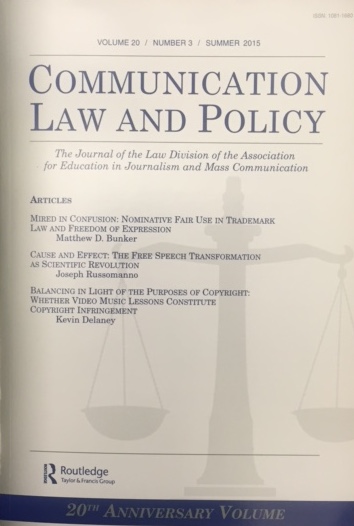
Pic 2UNC media law graduate Kevin Delaney has had an article published in Communication Law and Policy.  The article is “Balancing in Light of the Purposes of Copyright: Whether Video Music Lessons Constitute Copyright Infringement.”

The article addresses the question of whether it is a violation of copyright law for an individual to create and upload to the Internet a video music lesson in which the creator teaches viewers how to play a copyrighted song. The article argues that the defense of fair use should protect creators of video music lessons from liability in a copyright lawsuit, and specifically that video music lessons further the objective of copyright law – to promote learning.  The article says, in part, “Because video music lessons promote copyright’s aim of creating a more informed populace, our copyright laws should encourage – not detract – from the creation of such works.”

This is the citation for the article: Kevin Delaney, Balancing in Light of the Purposes of Copyright: Whether Video Music Lessons Constitute Copyright Infringement, 20 Comm. L. & Pol’y 261 (2015).

Kevin wrote the article for a course in the UNC School of Law called Copyright and the Music Industry in the Fall of 2014.  In May he graduated from UNC’s dual-degree program, earning a master’s in mass communication and a J.D.  He now works for the Reporters Committee for Freedom of the Press.

Congratulations, Kevin!


0

Media Law Center Welcomes Prof. Papandrea and a new Ph.D. Student

A senior scholar and a new Ph.D. student have joined UNC’s community of media law scholars.  The Center for Media Law and Policy is happy to welcome Professor Mary-Rose Papandrea and Ph.D. student Shao Chengyuan.

ProfPapandrea3Mary-Rose Papandrea came to the UNC School of Law this summer from Boston College Law School. Her teaching and research interests include constitutional law, media law, torts, civil procedure, and national security and civil liberties.

After graduating from Yale College and the University of Chicago Law School, Professor Papandrea clerked for U.S. Supreme Court Justice David H. Souter as well as Hon. Douglas H. Ginsburg of the U.S. Court of Appeals for the D.C. Circuit and Hon. John G. Koeltl of the U.S. District Court for the Southern District of New York. She then worked as an associate at Williams & Connolly LLP in Washington, D.C., where she specialized in First Amendment and media law litigation. In addition to spending over a decade at Boston College Law School, Professor Papandrea taught as a visiting professor at the University of Connecticut School of Law, Fordham Law School, Wake Forest Law School, and the University of Paris (Nanterre).

Co-author of the casebook Media and the Law (LexisNexis, 2nd ed. 2014) (with Lee Levine, David Ardia & Dale Cohen), Professor Papandrea has written extensively about government secrecy and national security leaks, the reporter’s privilege, student speech rights, the First Amendment rights of public employees, and the U.S. Supreme Court and technology.

Professor Papandrea has also served as the chair of the American Association of Law School’s Mass Media Law and National Security Law sections and remains on the executive committee of both sections. She is currently a member of the editorial board for the Journal of National Security Law & Policy. In addition, she has served on the board of directors for the American Civil Liberties Union of Massachusetts.

ShaoShao Chengyuan came to the UNC School of Media and Journalism from Beijing, China. She earned a master’s in communication from Beijing Foreign Studies University and a bachelor’s in English from China Agricultural University in Beijing. She has been studying media law issues in China, specifically new media-related legislation and the legal boundaries of online free speech. She also has worked as a television news producer for Spanish TV Etib’s Beijing Bureau. Her research interests include Internet policy and governance, freedom of expression, online anonymity, and government information publicity. She is planning to conduct comparative media law research.


0