Tag Archives | Events

Police Body-Worn Cameras: Time to Roll Up Our Sleeves and Study the Issues

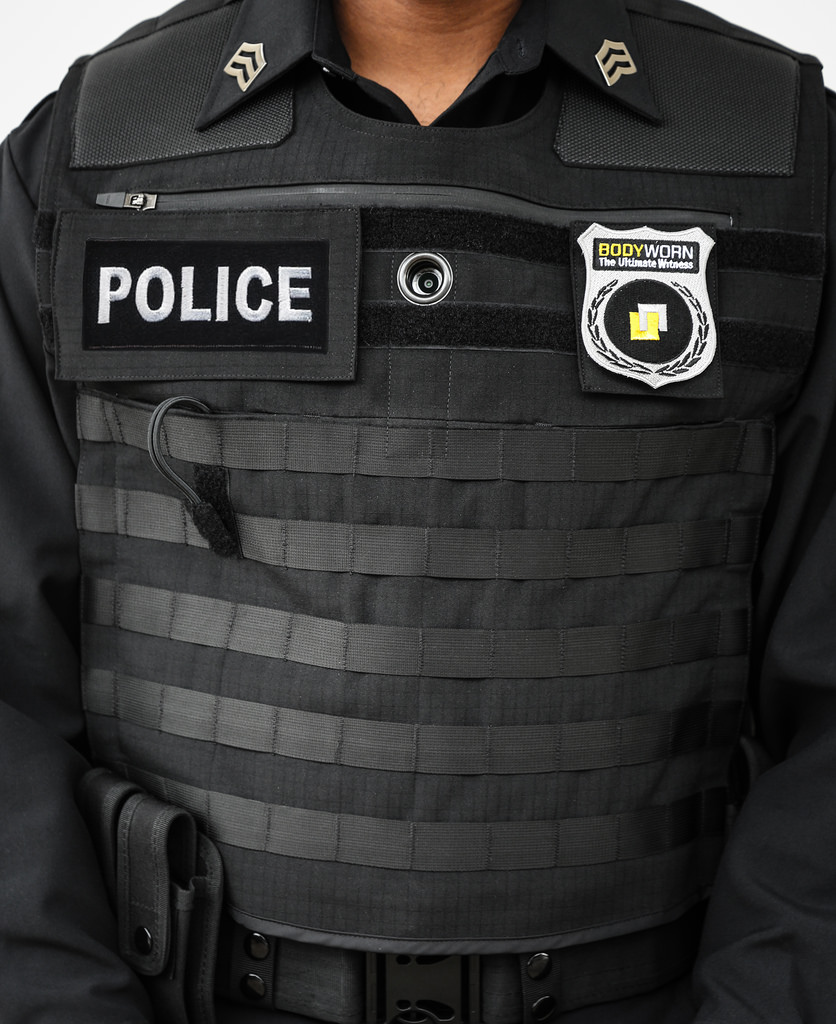
We are excited for the North Carolina Law Review’s symposium this Friday on “Badge Cams as Data and Deterrent: Law Enforcement, the Public and the Press in the Age of Digital Video.” The symposium will consider the legal and practical issues surrounding the use of police body-worn cameras (BWCs). Many of the nation’s leading experts on this topic will be in attendance, including:

  • Mary Fan, University of Washington
  • David Harris, Pittsburgh Law School
  • Woody Hartzog, Northeastern University
  • Margaret Hu, Washington and Lee University
  • Margot Kaminski, University of Colorado
  • Adam Marshall, Reporters Committee for Freedom of the Press
  • Bryce Newell, University of Kentucky
  • Jay Stanley, Senior Policy Analyst at the ACLU
  • Seth Stoughton, University of South Carolina
  • Peter Swire, Georgia Tech
  • Howard Wassermann, Florida International University
  • Michael White, Arizona State University

The symposium will consist of three panels: Professor Richard Myers will moderate a panel on collection and use of BWC video; Center co-director David Ardia will moderate a panel on privacy and public access; and Center affiliate faculty Mary-Rose Papandrea will moderate a panel on accountability. It will take place on November 3 from 8:30 a.m. to 4:30 p.m. at the George Watts Hill Alumni Center. For more information about the symposium, including information on how to register, please visit our event page.

As a supplement to the symposium, the Center is also organizing a private workshop on November 4 at the UNC School of Law to address the practical issues associated with the implementation of police body-worn camera systems. The workshop will be made up of experts on law enforcement, privacy, public access, and news gathering, with the goals of ascertaining areas of agreement, identifying issues that would benefit from additional academic research, and developing best practices for police departments and the media.

We will have more to say about the workshop next week!
0

UNC First Amendment Day is Tuesday!

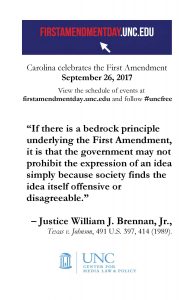
It’s almost time for what we at the UNC Center for Media Law and Policy think is the best day of the year! On Tuesday, Sept. 26, UNC will celebrate its ninth-annual First Amendment Day! This day of events is one of the highlights of the year at the Center, and we are thrilled to share it with our wonderful campus.

We have an exciting schedule for our day-long event this year.  From public readings of banned books to panels on the state of campus speech, this year’s First Amendment Day is sure to foster meaningful discussion about the state of the First Amendment as well as the University’s unique role in the marketplace of ideas.

This year’s Opening Ceremony will kick-off the day at 9:30 a.m with great speakers, including Center Co-Directors Dr. Cathy Packer and Professor David Ardia. In addition, we will hear from School of Media and Journalism Dean Susan King and UNC student body president Elizabeth Adkins. Next will be a student debate on Ethics and the First Amendment at 11:00 a.m. The debate will cover two issues: offensive speech in comedy performances and limitations on religious freedoms in the U.S. military. Following the debate, the Law School will host a panel on the Future of Free Expression, which will include a discussion of the state’s recent Campus Free Speech Act. Panelists include N. C. Rep. Jonathan Jordan and Professor Mary-Rose Papandrea, UNC Law’s Dean of Academic Affairs.

Starting at noon, members of the Coalition of Youth Librarians (COYL) and others from the UNC School of Information and Library Science (SILS), including SILS Dean Gary Marchionini, will participate in a reading of books that have been banned from school and public libraries. The readings will continue until 2:30 p.m.

To kick off the afternoon, retired Marine Corps sergeant and investigative journalist Thomas Brennan will speak at the at the Reese News Lab in Carroll Hall at 1:00 p.m., discussing how his work led to Congressional investigations and reform earlier this year. Next, we will tackle the state of campus speech at UNC directly with the panel titled, “Who Can Speak at Carolina?” The panel will include speakers from across campus, including Gabbie Johnson, a recent UNC Law grad and participant in the Silent Sam sit-in; Carolina Review and Daily Tar Heel contributors; and the Center’s own Research Fellow, Rachael Jones. Then, at 3:30 p.m., UNC student journalists from The Daily Tar Heel, Carolina Week, and other student publications will discuss how their work is affected by negative public opinion about the press, social media, and more. 

Leading up to our keynote address, the Carolina Ukulele Ensemble will celebrate the right to make music in Carroll Hall starting at 6:30 p.m. Finally, our keynote speaker, Professor Bill Adair, will discuss the future of the free press. Professor Adair is the creator of the Pulitzer Prize-winning website Politifact. He is the director of the DeWitt Wallace Center for Media and Democracy and the Knight Professor of the Practice of Journalism and Public Policy at Duke University.

To wrap up our free-speech-filled day, we are hosting a First Amendment Trivia night at Linda’s Bar and Grill! The questions start at 8:00 p.m. You can compete to test your knowledge of the First Amendment rights or simply sit back and enjoy the fun. Either way, it will be a fun (and competitive) end to a great day.

We hope to see everyone at our many events this year! For more information on the schedule, events, speakers, and history of First Amendment Day, visit our webpage. Don’t forget to share your photos and thoughts from the day with us by using the hashtag #uncfree! If you have any questions, feel free to contact the Center.

See you Tuesday!

0

Center Co-Director to Join Discussion of Section 230 and Backpage.com

Media Law Center Co-Director Cathy Packer will participate in a panel discussion following a screening of the documentary I Am Jane Doe on campus next week. The film chronicles the legal battles of three young girls who were trafficked through the advertising website Backpage.com

Packer will join panelists from UNC Project Dinah, Project FIGHT, and the Orange County Rape Crisis Center to discuss the many issues surrounding Section 230 of the Communications Decency Act, the federal law that limits websites’ liability for content that others post on their sites. Section 230 has long been hailed as one of “the most valuable tools for protecting freedom of expression and innovation on the Internet.” However, the law has been subjected to intense scrutiny since the classified advertisement website Backpage.com escaped liability after it was revealed that some of the site’s users used the site for sex trafficking.

The panelists will address the problems and benefits of Section 230, including recent federal legislation aimed at amending its broad reach. Ultimately, the panel will discus the necessary balance between Internet freedom and user protections.

The event will be held on September 14th at the UNC School of Social Work Auditorium on Pittsboro Street. The screening will begin at 7 P.M. Admission is free. Attendees are encouraged to submit questions for the post-film discussion with the panel via Twitter, using @Project_NO_REST, #IAmJaneDoe. The panel will also take questions live in the auditorium.

For more information about the film, visit its website. If you have questions about the event, contact Jennie Vaughn at jsvaughn@email.unc.edu.

We hope to see you there!

0

Video Available for “Freedom of the Press and the Trump Administration”

The video from the Center’s discussion of “Freedom of the Press and the Trump Administration” is now available on Vimeo.  The March 21 event was headlined by George Freeman, executive director of the Media Law Resource Center and former assistant general counsel of the New York Times Co., who discussed the challenges to press freedom that are likely to arise (and have already arisen) under the Trump administration. Mr. Freeman provided opening remarks on this subject and then sat down with Professor Mary-Rose Papandrea, a noted First Amendment expert, for an open-ended conversation that explored the administration’s positions on executive branch transparency, journalists’ access to government officials, whistleblower protections, the scope of defamation law, and respect for journalists, among other topics.

You can view the video here:


Freedom of the Press and the Trump Administration from Center for Media Law and Policy on Vimeo.

2

True Threats and Free Speech

The extent to which the First Amendment protects threatening messages on Facebook and elsewhere will be the subject of a panel discussion at the UNC School of Law at noon on Monday, Jan. 26.

Co-sponsored by the UNC Center for Media Law and Policy, the discussion will focus on Elonis v. United States, a case recently argued before the U.S. Supreme Court. You can read more about the event here.

One of the panelists will be UNC School of Journalism and Mass Communication Ph.D. student Brooks Fuller, who recently had an article about threatening Internet messages and the First Amendment published in the Hastings Communication & Entertainment Law Journal. The citation is: P. Brooks Fuller, Evaluating Intent in True Threats Cases: The Importance of Context in Analyzing Threatening Internet Messages, 37 Hastings Comm. & Ent. L. J. 37 (2015).

From the abstract:

Following the Supreme Court’s most recent ruling on the true threats doctrine, Virginia v. Black (2003), significant conflict emerged among the federal circuit courts. The primary issue became whether the First Amendment, as interpreted by the Court in Virginia v. Black, requires a subjective intent standard to be read into all statutes that criminalize true threats, or whether the First Amendment only requires such a statute to require the prosecution to demonstrate that a reasonable person would consider the message to be a true threat. Speakers’ use of social networking websites and Internet forums for the purposes of posting violent and intimidating communications raises significant questions regarding the posture of the true threats doctrine and its application to modern modes of communication. In June 2014, the Supreme Court granted certiorari in Elonis v. United States, a true threats case involving posts on Facebook. The defendant, who posted violent messages in the form of rap lyrics and other pop culture references, argued that the trial courts misread Virginia v. Black and violated his First Amendment rights when it failed to instruct the jury to consider his subjective intent in addition to the objective standard. This paper utilizes legal research methods to examine federal courts’ treatment of Internet threats and highlights aspects of Internet speech that are particularly problematic for the true threats doctrine.

0