

Archive | Internet

2026 Hargrove Colloquium–The Regulator’s Dilemma: Innovation and Global Competition

On April 6, the UNC Center for Media Law and Policy will host the 2026 Hargrove Media Law and Policy Colloquium, featuring Kevin Martin, vice president and head of global policy at Meta and former chairman of the Federal Communications Commission. Titled The Regulator’s Dilemma: Innovation and Global Competition, the event will explore how regulators and industry leaders can respond to rapid technological change while fostering innovation and maintaining competitiveness in an increasingly global media and communications marketplace.

Mr. Martin brings a rare combination of senior government, private practice, and global policy experience to this conversation. He served two terms as commissioner and chairman of the FCC during a period of significant transformation in telecommunications, broadband, and media regulation. Before joining the FCC, he worked at the White House as a Special Assistant to the President for Economic Policy and as a member of the National Economic Council staff, where he focused on commerce and technology policy. He also represented the United States on the G‑8 Digital Opportunity Task Force, addressing how the digital revolution could expand opportunity in developing countries. After leaving government service, Mr. Martin was a partner and co-chair of the telecommunications practice at an international law firm before joining Meta, where he now leads global engagement with policymakers on privacy, connectivity, trade, and related issues.

In addition to delivering prepared remarks, Mr. Martin will sit down for a conversation with Julia Ambrose, who clerked for Associate Justice Sandra Day O’Connor and now leads the media law practice at Brooks, Pierce, McLendon, Humphrey & Leonard, LLP. Their discussion will examine the practical and philosophical tensions between regulation and innovation, the growing importance of international policy considerations, and the role lawyers play in advising clients amid regulatory uncertainty and global competition.

Designed for lawyers, media and technology industry leaders, policymakers, and students, the evening will offer a thoughtful and timely examination of the regulatory choices shaping the future of media and communications. The event will also highlight the enduring relevance of media law and policy education at a moment when regulatory decisions increasingly influence innovation, democratic values, and economic growth worldwide.

The colloquium will take place on April 6 at 7:00 p.m. at the Paul J. Rizzo Conference Center, 130 DuBose Home Lane, Chapel Hill, NC 27517. The event is free and open to the public, though advance registration is encouraged due to limited seating. Registration is available here.

For more information on the Colloquium, please visit our event page.
0

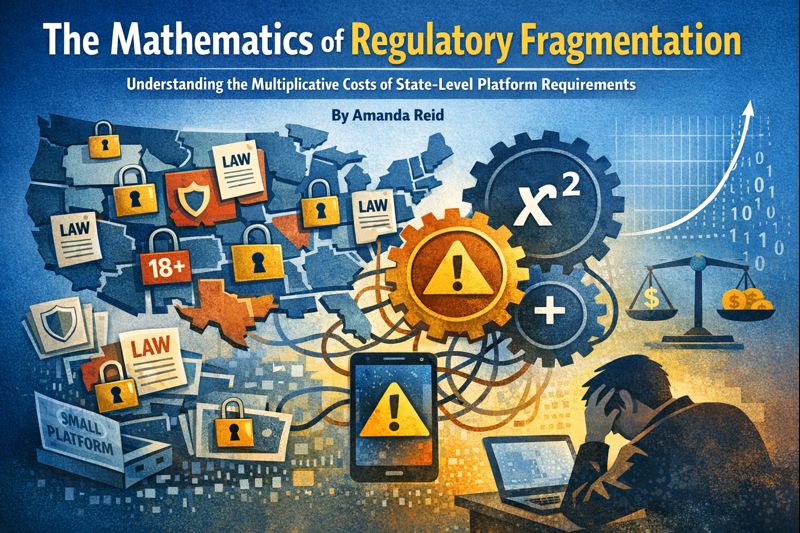
Article: The Mathematics of Regulatory Fragmentation

This study explores the rapidly evolving landscape of state-level digital platform regulation in the United States and uncovers a surprising mathematical dimension to how overlapping laws impact technology design, compliance costs, and market dynamics.

MATHEMATICS OF REGULATORY FRAGMENTATION

🔍 What the Research Explores

State governments have introduced a patchwork of social media safety laws that impose technical mandates on online platforms — especially aimed at enhancing user protections such as youth safety. While well-intentioned, these regulations do not simply add compliance costs as jurisdictions pile on more rules. Instead:

  • Each new state requirement interacts with every other, creating multiplicative — not additive — technical burdens for platforms.

  • This exponential growth in complexity stems from a combinatorial reality: as more distinct regulations are introduced, the number of potential conflicts and design constraints multiplies rapidly.

  • Smaller platforms and new market entrants are particularly disadvantaged, as they face disproportionately high engineering and operational costs to satisfy conflicting rules across jurisdictions.

  • Ironically, regulatory fragmentation may also undermine the very safeguards these laws are meant to provide, by incentivizing workarounds and fragmenting the user experience.

📌 Why It Matters

This research highlights a critical, often overlooked dimension of digital policy: the interactions between laws matter just as much as the content of the laws themselves. By applying mathematical reasoning to regulation, this work provides policymakers, researchers, and technologists with a new lens for assessing the real-world effects of decentralized digital governance.

The paper contributes to debates on platform regulation, digital governance, and the economics of compliance: topics that are central to recent legislative efforts across the U.S. and around the world.

📥 Read the Paper

The full paper (58 pages) is available on SSRN.

0

[Article] Nerd Harder: A Typology of Techno-Legal Solutionist Logics in Child Online Safety Laws

Co-authored with Lorcan Neill and Evan Ringel, our project examines recently enacted state-level child online safety laws (COSLs) and demonstrates how different techno-legal solutionist logics manifest in these legislative efforts.

Our analysis demonstrates three interdependent patterns: (1) the checklist fallacy (reducing safety to discrete technical features), (2) the false promise of age verification (assuming identity verification will prevent harm), and (3) the design determinism myth (overestimating design’s power to shape social outcomes).

The appeal of techno-legal solutionism transcends borders–from California to Brussels, it offers policymakers seemingly clear solutions to complex problems. However, our analysis shows that this approach fundamentally misunderstands both the social shaping of technology and the complexity of youth well-being. Technologies can influence outcomes by offering (or not) certain design features (i.e., affordances); yet these designs do not determine the outcomes. This overconfidence that technology can determine an outcome risks ignoring the more complex and nuanced forces shaping children’s online experiences. Moving forward requires abandoning the fallacy that we can simply “nerd harder” our way to youth safety—and instead embracing the more challenging work of developing comprehensive, nuanced approaches that recognize both the limitations and possibilities of technical intervention.

The Article is open access here.

Nerd Harder Website Graphic

0

New article: “Digital intermediaries and transparency reports as strategic communications”

ReidRingelA new study authored by Amanda Reid and Evan Ringel examines how “transparency reports” have become an institutionalized practice among digital intermediaries. This work frames platforms’ transparency reports as corporate social responsibility (CSR) disclosures, and it argues they represent an emerging institutional practice shaped by isomorphic pressures (organizations becoming more similar by mimicking each other).  Moreover, the article notes that while CSR research exists in other sectors, there’s a gap in studying CSR in the tech sector.  This research makes two main theoretical contributions.  First, the empirical evidence shows how this practice has spread across companies and across jurisdictions around the world.  And second, it offers a two-fold explanation for why different companies do this: (1) Big Tech companies use them as legitimacy-seeking strategic communications, and (2) SMEs (small and midsize enterprises) copy Big Tech’s practices through “mimetic isomorphism.”

Amanda Reid & Evan Ringel, Digital Intermediaries & Transparency Reports as Strategic Communications, 41 The Information Society 91-109 (2025) doi: 10.1080/01972243.2025.2453529.

See also Amanda Reid, Evan Ringel & Shanetta M. Pendleton, Transparency Reports as CSR Reports: Motives, Stakeholders, and Strategies, 20 Social Responsibility Journal 81-107 (2024), doi: 10.1108/SRJ-03-2023-0134; Amanda Reid, Shanetta M. Pendleton & Lightning E.H. JM Czabovsky, Big Tech Transparency Reports & CSR: Longitudinal Content Analysis of News Coverage, 13 The Journal of Social Media in Society 122-154 (2024), https://www.thejsms.org/index.php/JSMS/article/view/1447/693

0

2024 Hargrove Colloquium: Media Law in the Age of Artificial Intelligence

Generated by AI with Copilot Designer

On April 16, 2024, the Center for Media Law and Policy will be hosting the 2024 Hargrove Colloquium.  The topic for this year’s colloquium is Media Law in the Age of Artificial Intelligence. Come hear from David McCraw, deputy general counsel at The New York Times Co. and author of the book Truth in Our Times: Inside the Fight for Press Freedom in the Age of Alternative Facts, as well as Ruth Okediji from Harvard Law School, who served as a member of the National Academies’ Board on Science, Technology and Policy Committee on the Impact of Copyright Policy on Innovation in the Digital Era.

Our distinguished panel of experts will examine efforts at the federal and state level to prevent potential abuse of AI and will delve into the impact of generative AI on critical areas of media law, offering insights and sparking thought-provoking discussion. Key areas of focus will include:

  • Copyright Law: Who owns the creative output generated by AI? What is the impact on copyright holders when their work is used in training AI systems? How will existing copyright frameworks adapt to accommodate generative AI?
  • Defamation and Tort Law: Who, if anyone, can be held liable for harmful or defamatory content that AI generates? What are the legal implications for users and platforms employing AI-powered algorithms to curate and publish information?
  • Political Communication: How is AI being used in political campaigns and advertising? What are the potential risks and safeguards around AI-powered misinformation and voter manipulation?
  • Journalism: How is AI transforming the news industry? What are the legal and ethical considerations surrounding AI-generated news? How can journalists leverage AI while upholding journalistic integrity?

The Colloquium will take place at 7:00 PM at the George Watts Hill Alumni Center at the University of North Carolina and is free and open to the public. Visitor parking is available in the Rams Head Parking Deck.

You can read more about the colloquium on our event page.

0