
Archive | First Amendment

United States Supreme Court to hear Facebook true threats case

For the first time since the now-famous Virginia v. Black (2003) cross-burning case, the Supreme Court is set to hear arguments in a “true threats” case. Commentators expect the Court to clarify confusion that has arisen among the federal circuit courts regarding whether the First Amendment requires courts to consider the speaker’s subjective intent when prosecuting the speaker under a criminal threat statute. The case, Elonis v. United States, also presents the Court with an opportunity to determine whether the true threats doctrine has evolved along with modes of online communication.

Elonis involves a defendant who was convicted in federal district court under title 18, section 875(c) of the United States Code, which criminalizes the transmission of a threatening communication in interstate commerce, including over the Internet. Anthony Elonis posted to his Facebook wall a series of posts that made references to rap lyrics by artist Eminem and a sketch comedy routine that satirized threats against political figures. The posts also used violent imagery and language to describe Elonis’s disdain for his wife, who had recently left him and taken custody of the couple’s two children. One of Elonis’s posts read as follows:

“Did you know that it’s illegal for me to say I want to kill my wife?

It’s illegal.
It’s indirect criminal contempt.

It’s one of the only sentences that I’m not allowed to say.
Now it was okay for me to say it right then because I was just telling you that it’s illegal for me to say I want to kill my wife.

I’m not actually saying it.
I’m just letting you know that it’s illegal for me to say that.
It’s kind of like a public service.
I’m letting you know so that you don’t accidently go out and say something like that
Um, what’s interesting is that it’s very illegal to say I really, really think someone out there should kill my wife.…

I also found out that it’s incredibly illegal, extremely illegal, to go on Facebook and say some- thing like the best place to fire a mortar launcher at her house would be from the cornfield behind it because of easy access to a getaway road and you’d have a clear line of sight through the sun room. Insanely illegal.

Ridiculously, wrecklessly [sic], insanely illegal.

Yet even more illegal to show an illustrated diagram.


===[ __ ] =====house :::::::::::::::^

::::::::::::::::::::::::::::::::::::::::::cornfield

:::::::::::::::::::::::::::::::::::::::::::::::::::::::::::

:::::::::::::::::::::::::::::::::::::::::::::::::::::::::::

:::::::::::::::::::::::::::::::::::::::::::::::::::::::::::

#########################getaway road


Insanely illegal.
Ridiculously, horribly felonious.”

Elonis followed that post with a link to a YouTube video posted by sketch comedy troupe the Whitest Kids U Know. The post tracked the language of the YouTube video nearly verbatim, evoking its cadence and core message, but focused on Elonis’s wife rather than the President. Another post purportedly made reference to Eminem’s song “I’m Back,” in which Eminem criticized his ex-wife and fantasized about participating in a school shooting.

Throughout the trial, Elonis, who adopted the online rap moniker “Tone Dougie,” testified that Facebook operated as a forum for venting his frustrations and anxieties about his home life. Elonis testified that he was not Facebook friends with his wife and that he never tagged her in the posts. He has always claimed that he lacked any specific intent to threaten her life.

At the heart of Elonis v. United States is the meaning of a key phrase in Justice O’Connor’s majority opinion in Virginia v. Black. Justice O’Connor stated that a true threat occurs when a speaker “means to communicate” a serious expression of an intent to commit an act of unlawful violence. But does this language require the prosecution to prove that someone like Anthony Elonis subjectively intended to threaten his wife or merely that he meant to distribute a communication some reasonable person would regard as a true threat?

In clarifying Justice O’Connor’s language, the Court may raise profound questions about how social media either facilitate or cloud the meaning, whether threatening or non-threatening, intended by speakers who use social media for catharsis.

If the Court imposes a subjective intent standard on all true threats statutes, then a defendant’s fondness for Eminem’s violent lyrics or anti-establishment comedy sketches becomes increasingly relevant and allows the jury to consider the meaning underlying cultural tropes such as gangster rap that frequently evoke violent imagery for expressive, artistic purposes.

If the Court follows the majority of the federal circuit courts and upholds the objective reasonable person standard as the only constitutional requirement under Black, then it would seem to signal that speakers in open Internet forums bear the responsibility for all reasonable interpretations of their incendiary posts, even when they lack the specific intent to threaten.

Elonis also advances the theoretical discussion of how social media create and sustain connections between speakers and listeners even when individual posts are not directed at certain persons or groups. Facebook operates as a communication ecosystem that thrives on “shares” and “likes.” The community decides the reach and value of speech, and the online community is empowered to distort the speaker’s intent and the message’s context. The Supreme Court now has an opportunity to decide whether intent matters in determining whether a speaker should bear criminal responsibility for planting a message in the Facebook ecosystem that may be palatable to some users and poisonous to others.


Brooks Fuller is a Roy H. Park Fellow and Ph.D Student at the UNC School of Journalism and Mass Communication. Follow him on Twitter at @itsPBrooks

0

FAA Releases Notice Concerning Model Airplane Rule

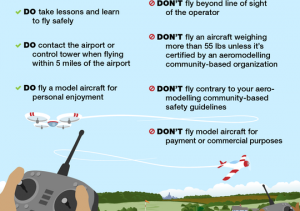
FAA released drone noticeBackyard flying is more complex than Snoopy battling the Red Baron, and you might be surprised at how much debate goes into just what is and what isn’t a model airplane. The FAA released a “Notice of Interpretation” in an effort to clarify the model airplane exception of the FAA Modernization and Reform Act of 2012, which said that devices considered to be model airplanes could operate without FAA approval or regulation.

The notice and accompanying press release say that the original law that applies to model airplanes does not apply to model airplanes that are being used for commercial purposes or flown in an unsafe manner. It also gives examples, as this picture shows, of what aircraft uses will and won’t be allowed. This notice might address one of the legal issues in the Pirker case currently going through the appeals process.

While the FAA’s efforts might be for clarification, they are being met with some resistance and skepticism. The Academy of Model Aeronautics released a statement saying it was “extremely disappointed and troubled.” One author said this notice just added to the confusion.

The notice is published in the Federal Register and takes effect immediately, but the FAA will take public comment for 30 days.

0

New Media Law PhDs

UNCThe UNC School of Journalism and Mass Communication will welcome three new media law students to its Ph.D. program this fall.  All of them have expressed interest in working in the UNC Center for Media Law and Policy.  Welcome, law dawgs!

These are the students and a brief description of each student’s background and research interests:

Nicholas Gross.  Coming to Carolina from San Jose, Calif., Nicholas earned a J.D. from the University of Miami School of Law and a bachelor’s degree in economics and international relations from the University of California, Davis. Currently Nicholas is a legal research attorney for The Superior Court of California, County of Santa Clara. He also has been a staff attorney with the U.S. Court of Appeals for the Eleventh Circuit in Atlanta, GaHis research interests include freedom of expression, internet policy and governance, advertising, intellectual property law, privacy and security law, and telecommunications regulation.

Taeho Lee.  A native of Korea, Taeho earned a J.D. from Emory University and a bachelors in communication from Seoul National University in Korea. He has practiced law in Nashville and Chattanooga, Tenn., and he has advised Fox Television Stations Inc. in Atlanta on diverse legal matters, including state shield laws. He also has assisted lawyers in drafting copyright license agreements between cable networks in Atlanta. He is interested in studying the relationship between protection of privacy, freedom of expression, and potential harm from offensive speech (e.g., violent, indecent, and racially discriminative speech).

Kristen Patrow is coming to Carolina from Minneapolis, Minn. She earned a master’s degree in mass communication from the University of Minnesota and a bachelor’s in journalism from Bethel University. She has been a teaching assistant for several journalism courses at the University of Minnesota and guest lectured in classes. Her professional experience includes being an events coordinator and social media associate for Christians for Biblical Equity. She organized conferences and wrote articles for newsletters and magazines. She is planning to study media law, especially the First Amendment and how low-value speech, such as pornography, contributes value to a community.

0

FAA Approves First Commercial Drone Flight Over US Land

Drone

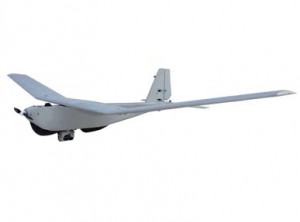
Picture of the Puma AE

In the words of famed, fictitious race car driver Ricky Bobby: “if you ain’t first, your last.” Future commercial drone users might prefer to come in second, but first place belongs to BP, as they received the first ever FAA clearance to fly a drone over domestic land for commercial purposes. While ConocoPhillips was approved for a drone flight towards the end of last year, that flight was only approved over water.

Don’t think this is going to cause widespread changes just yet. As the article points out, BP had to comply with very strict standards and policies in order to get approval. Still, they received FAA approval and their Puma AE drone and its 9.2 foot wingspan was up and flying on June 8. Strict guidelines or not, this approval is definitely a big development in the future of commercial drone use.

(Picture directly from Aerovironment website (the company that produces the Puma AE))

(h/t to my father, Roger Hannah, for alerting me to this story)

0

Students Presenting at AEJMC Conference in August 2014

AEJMC LogoThree Carolina students have had media law research papers accepted by the Law and Policy Division of the Association for Education in Journalism and Mass Communication (AEJMC) for presentation at the group’s annual conference in Montreal in August.  Congratulations!

These are the authors, theory paper titles, and their paper abstracts:

Kevin Delaney, a student in the dual-degree program earning a J.D. and a master’s in mass communication, wrote “Rube Goldberg-Like Contrivances and Broadcasting:  The Litigation Challenging Aereo.”

Abstract:  The broadcast industry has been abuzz over Aereo, a company that streams broadcast content without a license over the Internet to subscribers.  The nation’s broadcasters have sought to enjoin Aereo by arguing that Aereo’s service violates their right under the Copyright Act of 1976 to perform works publicly.  This paper explores Aereo’s service in the context of the public performance right and offers an argument for how courts should interpret the public performance right.

Kylah Hedding, a Roy H. Park Fellow and Ph.D. student in the UNC School of Journalism and Mass Communication, wrote “Does Access to Environmental Information have a Critical Problem?:  Interpretation of FOIA’s Exemption 4 after the Critical Mass III Decision.” This paper won a prize for being the second best student paper in the Law and Policy Division.

Abstract: The Environmental Protection Agency (EPA) is one of the top agencies to invoke Exemption 4 when denying FOIA requests, which exempts from disclosure “trade secrets and commercial or financial information obtained from a person and privileged or confidential.” However, the exemption provides no definitions for these key terms, which has been problematic for federal agencies and forced the federal appeals courts to define them. The first major case to establish an Exemption 4 precedent was National Parks v. Morton decided by the District of Columbia Circuit in 1974. The second major case, which either clarified or overturned this precedent, depending on which legal scholar is writing about it, was Critical Mass v. NRC decided in 1992 by the same federal appeals court. This paper examines how Critical Mass v. NRC has influenced the interpretation of Exemption 4 by the federal appeals courts.

Brooks Fuller, another Roy H. Park Fellow and PhD. student in the J-School, wrote “Evaluating Intent in True Threats Cases:  The Importance of Context in Analyzing Threatening Internet Messages.”

Abstract:  Following the Supreme Court’s most recent ruling on the true threats doctrine, Virginia v. Black (2003), significant conflict emerged among the federal circuit courts. The primary issue is whether an objective or subjective standard should apply to statutes that criminalize threats.  Speakers’ use of social networking websites and Internet forums for the purposes of posting violent and intimidating communications raises significant questions regarding the posture of the true threats doctrine and its application to modern modes of communication.  This paper utilizes legal research methods to examine federal courts’ treatment of Internet threats and highlights aspects of Internet speech that are particularly problematic for the doctrine.  Ultimately, this paper calls for the Supreme Court to revisit the true threats doctrine in light of significant inconsistency among the circuits regarding the impact of the Internet on recipients of threatening communications.
Papers for this national competition are double-blind reviewed, and student papers compete for acceptance on equal footing with faculty and co-authored papers.

All these paper were written for media law classes in the Journalism School.

0