
Author Archive | David Ardia

Privacy by Design: A Student Guide for Collecting and Protecting User Data

As we start the new semester at UNC – Chapel Hill, I want to reflect briefly on a class I taught last spring and highlight the great work of some of the students in that class.

For the past six years, I’ve taught a class called Media & Internet Law Practicum.  This is a class I designed shortly after joining the faculty at the UNC School of Law.  My goal was to give students the chance to see what it is like to work in the legal department at a diversified media company. I play the role of  “general counsel” and the students, who are assigned to 3-4 person teams, serve as “associate counsel.” In addition to their classroom work, the teams are embedded in one of several ongoing news-producing projects at the UNC School of Media and Journalism, including Carolina Week (television program), Carolina Connection (radio program), Media Hub (multimedia), and Reese News Lab (startup incubator), where the law students work with undergraduate and graduate student journalists.  Through a combination of in-class simulations and real-world problems arising from their projects, the students gain substantial insight into how in-house lawyers provide legal counseling to media and Internet clients.

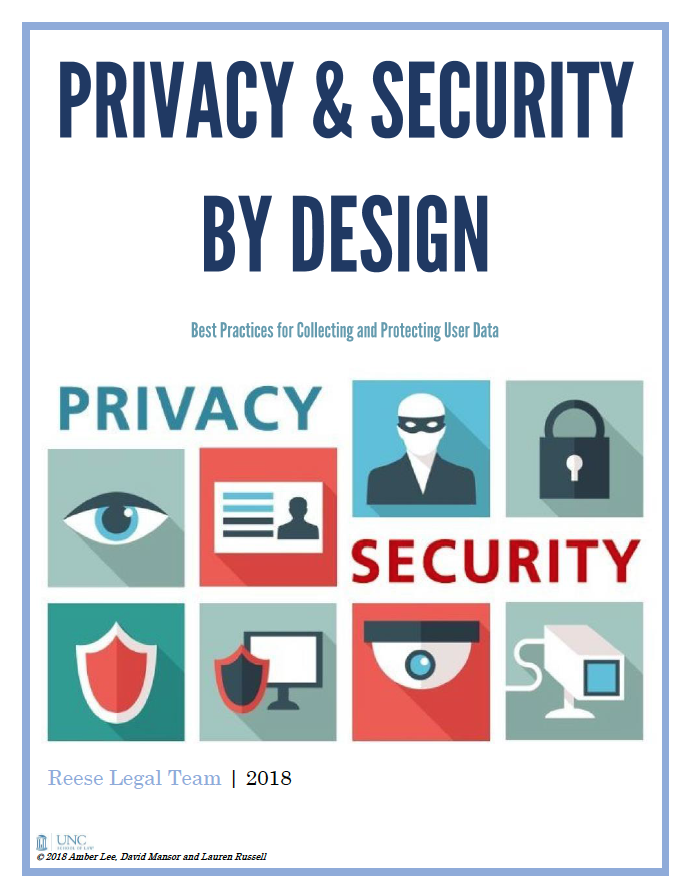
At the end of the semester I ask each student team to create a tangible resource/guide that addresses an ongoing legal need for their project.  Over the years, the students have created some fantastic things, including copyright and fair use guides, a primer on FERPA, a pocket summary of a reporter’s legal rights when engaged in newsgathering, fair use training aids, and most recently, a guide titled “Privacy and Security by Design: Best Practices for Collecting and Protecting User Data.” This very useful brochure was created by Amber Lee, David Mansor, and Lauren Russell to help the students in the Reese News Lab avoid legal problems when developing new apps and services. They graciously agreed to allow me to share their work with all of you.

Here is a snippet from the introduction:

No matter what your product is, whether it be an app to inform users on local elections, or a payment service for 20-something drinkers trying to avoid long lines at the bar, you will likely be collecting information from your users. Collecting information about your users allows you to better personalize services and marketing, and sharing the information in an appropriate way could potentially be a revenue stream for your company. Almost all websites—including the Federal Trade Commission’s, the federal agency that polices private companies’ cybersecurity—collect some information on its visitors. But startups should tread carefully. Successful tech companies ranging from Uber to Google to Facebook have gotten into trouble with the FTC and have lost public trust for mishandling user data. It is important to think about users’ privacy throughout your product design and development process.

You can download the entire guide here.  Great work Amber, David, and Lauren!


0

Announcing the Center’s New Faculty Co-Director: Tori Ekstrand

I’m pleased to announce that Dr. Victoria “Tori” Smith Ekstrand, associate professor at the School of Media and Journalism, has been appointed to serve as a faculty co-director of the UNC Center for Media Law and Policy. Tori replaces Dr. Michael Hoefges, the Center’s dual-degree program advisor, who filled in as interim co-director following Cathy Packer’s retirement in December 2017 (Thank you, Michael!).

Tori has been deeply involved with the Center for many years, most recently serving as the Center’s communications director. Tori teaches media law courses at the School of Media and Journalism and is one of the nation’s leading experts on the “hot news” doctrine. Before coming to Carolina, she was an associate professor in the Bowling Green State University Department of Journalism and Public Relations and an affiliate faculty member of BGSU’s American Cultural Studies department. In 2008, she was awarded BGSU’s Outstanding Young Scholar Award.

Tori’s research explores conflicts between copyright law and the First Amendment, particularly as they arise in journalism and social media. Her work is often grounded in critical legal theory, in which she examines the impact of law and policy on culture and media production. In this vein, she has begun investigating online accessibility for the disabled as a First Amendment issue.  Tori has written two books on the hot news doctrine, a part of unfair competition law that protects the facts of news for a short period. Her revised book on the subject, Hot News in the Age of Big Data: A Legal History of the Hot News Doctrine and Implications for the Digital Age (LFB Scholarly, 2015), looks at the history of the doctrine and its impact on protections for discrete bits of information in the age of Big Data. She has also published articles in Journalism and Mass Communications QuarterlyCardozo Arts & Entertainment Law Journal and Communication Law & Policy. Before teaching, Tori worked for The Associated Press in their New York headquarters for nearly a decade. She served as AP’s director of Corporate Communications, responsible for marketing, public relations and events for the worldwide news agency.

Tori brings remarkable passion to everything she does. I’m thrilled that she is taking on an expanded role at the Center!

0

Summer Grants for UNC Law and Graduate Students Interested in Media Law and Policy

summer-job-pictureAre you interested in pursuing a career in media law or policy?  Are you worried that you won’t be able to take that plum summer job in New York, Washington, or Los Angeles because it’s just too expensive to live there.  Well, the Center for Media Law and Policy is here to help.  For the seventh year in a row, the Center will be providing grants to UNC law and graduate students who have a summer job in the field of media law or media policy.

The Center’s summer grants program provides funds to UNC law and graduate students taking unpaid or low-paying jobs in the fields of media law or media policy. In past years, UNC students have received a summer grant to support their work at a wide range of organizations, including the Federal Communications Commission, Federal Trade CommissionNational Public Radio, Electronic Frontier FoundationFoundation for Individual Rights in Education (FIRE), Future of Privacy Forum, Student Press Law Center, Broadway Video GroupAmerican Civil Liberties Union of Northern California, and Berkman Klein Center for Internet & Society.

Wait, you don’t have a summer job yet?!  Head over to our media law and policy Jobs Center, where you will find dozens of summer (and post-graduate) employment opportunities. You can easily find the perfect job for you by using our advanced search feature to search by location, keyword, or practice area.  Also, try browsing by job type or category for a more expansive look at the jobs listed. Still not sure what you want to do for the summer?  You can read about the summer experiences of your fellow students on the Center’s blog.

Requirements and Information on How to Apply for a Summer Grant

You must be a UNC law student or graduate student to apply. You will need to download the application form and send it directly to us at medialaw [at] unc.edu along with the other supporting material described below. Please put “Summer Grant Application” in the subject. The deadline for applying for a summer grant is April 2, 2018.

Law students who applied through the law school’s Summer Public Interest Grant Program are also eligible for a Center grant. You do not need to apply to the Center separately. Simply check the box on the general application for “Media Law or Policy” under the heading “Substantive Areas Your Summer Employment Will Involve” and you will be automatically considered for Center funds in addition to the law school grant.

Applications will be evaluated based on (a) your demonstrated commitment to working in the areas of media law or policy and (b) the quality of your essays (each essay should not be more than 500 words).

Required documents include:

  1. Resume (without grade information)
  2. Offer letter from your employer
  3. Essays (no more than 500 words each) *

* Essay questions:

  • Essay #1: Describe your work responsibilities and how they relate to media law or media policy.
  • Essay #2: Describe your commitment to public service. How have your past interests and work experiences contributed to your proposed summer internship responsibilities?
  • Essay #3: How do you see this summer work experience contributing to your long-term career goals?

Be sure to check out these Tips for Writing a Strong Grant Application. You will be notified of a decision in April.

0

Center’s Research Fellow Co-Authors Article on OnionDNS in Information Security Journal

Rachael Jones, the Center for Media Law and Policy’s new Research Fellow, is the co-author of an article published this month in the International Journal of Information Security. Congratulations, Rachael!

The article is titled “OnionDNS: a seizure resistant top-level domain.” It addresses the growing issue of Internet domain name seizures, noting the significant due process concerns that flow from this government practice. The authors propose a type of domain system, OnionDNS, that would provide a method of curtailing improper seizures by implementing safeguards in the design of the domain name system. First, the OnionDNS root services exists as a hidden service on the Tor network. Second, the proposed system is designed to protect its users by housing operations entirely outside of the United States, requiring any government seizure to pass through several hurdles—including foreign government cooperation. Thus, OnionDNS would not only curtail improper domain seizures as a tool of censorship, but also impose due process safeguards for domain name registrants.

From the abstract:

The Domain Name System (DNS) provides the critical service of mapping canonical names to IP addresses. Recognizing this, a number of parties have increasingly attempted to perform “domain seizures” on targets by having them delisted from DNS. Such operations often occur without providing due process to the owners of these domains, a practice made potentially worse by recent legislative proposals. We address this problem by creating OnionDNS, an anonymous top-level domain and resolution service for the Internet. Our solution relies on the establishment of a hidden service running DNS within Tor and uses a variety of mechanisms to ensure a high-performance architecture with strong integrity guarantees for resolved records. We then present our anonymous domain registrar and detail the protocol for securely transferring the service to another party. Finally, we also conduct both performance and legal analyses to further demonstrate the robustness of this approach. In so doing, we show that the delisting of domains from DNS can be mitigated in an efficient and secure manner.

The citation for the online version of the article is Scaife, N., Carter, H., Lidsky, L. et al. Int. J. Inf. Secur. (2017), https://doi.org/10.1007/s10207-017-0391-z.

0

A UNC Student’s Summer Experience at the FTC

From Amber Lee, a 3L at UNC School of Law, who interned at the Federal Trade Commission:

This past summer, I interned for the Bureau of Consumer Protection at the Federal Trade Commission in Washington, D.C. The FTC’s mission is to protect consumers by preventing anticompetitive, deceptive, and unfair business practices to enhance and inform consumer choices and public understanding of the competitive process. Specifically, the Bureau of Consumer Protection works to regulate and prevent unfair, deceptive, and fraudulent business practices by developing rules to maintain a fair marketplace, educating consumers and businesses on their rights and responsibilities, collect consumer complaints and conduct investigations, and sue companies or individuals that break the law. Over the course of the summer, interns had the unique opportunity to research the First Amendment issues of several cases the Bureau was considering pursuing, conduct our own investigations of company’s suspected of false advertising, collect consumer complaints and draft affidavits, and participate in both consumer and business education efforts.

During my time at the Bureau of Consumer Protection, I worked on projects with all five of the Bureau’s litigating divisions, including Advertising Practices, Marketing Practices, Enforcement, Financial Services, and Privacy & Identity Protection. I spent most of my summer researching and drafting memoranda on a wide variety of issues to either assist with pending litigation or assess the likely success or weaknesses of legal arguments for cases the Bureau was considering pursuing in the future. Some of my favorite projects included conducting my own independent investigation of a nutritional supplement company suspected of false advertising, assessing the legal strengths and weaknesses of a potential fraud case, researching emerging trends in the courts’ treatment of CDA immunity, and assisting an attorney with a presentation at a local senior center to educate residents about frauds and scams targeting  senior citizens.

The Bureau of Consumer Protection did a fantastic job of integrating the eight legal interns into their cases and into the agency. The internship coordinator hosted weekly meeting with the interns where we would either learn important legal skills or learn more about a division within the Bureau. We also had a mock deposition exercise with some of the best litigators in the Bureau acting as opposing counsel.  Each intern received an attorney mentor and every litigating division hosted a social gathering throughout the summer to give us a chance to meet all of the attorneys in the Bureau. Also, we were able to tour the Supreme Court and Library of Congress as a group during the summer, attend a Nationals baseball game, and attend a variety of ABA or other legal organization events focused on consumer protection or advertising law issues and interact with attorneys in private practice.

I would strongly recommend students to apply the FTC Consumer Protection internship program, especially if they are interested media law, advertising law, or emerging legal issues involving social media. The people I worked with were amazing and I could truly tell they wanted all of the interns to learn new skills and gain something from their experience at the FTC.

1