Archive | Center for Media Law and Policy

Content related to the Center for Media Law and Policy’s activities and people.

C-SPAN, UNC-TV to televise inaugural Hargrove Colloquium

C-SPAN and UNC-TV will televise today’s inaugural Wade H. Hargrove Communications Law and Policy Colloquium, hosted by the Center for Media Law and Policy. Hearst TV CEO David Barrett and ABC News President Ben Sherwood will discuss the future of TV news and the challenges and opportunities media companies face in this age of digital convergence.

The colloquium begins at 5:30 p.m. in the George Watts Hill Alumni Center on UNC’s campus and is free and open to the public. For more information, see the event page and a full description of the event and speakers by the Center’s co-director, David Ardia.

0

Symposium will contemplate 50 years of press freedom

Almost 50 years ago, Justice William J. Brennan Jr., writing for the Supreme Court, expressed “a profound national commitment to the principle that debate on public issues should be uninhibited, robust, and wide-open, and that it may well include vehement, caustic, and sometimes unpleasantly sharp attacks on government and public officials.”

Tomorrow, the UNC First Amendment Law Review will bring together media law experts to reflect on and debate just how free the press has been to cover and criticize public officials since the landmark ruling in New York Times Co. v. Sullivan, which established the “actual malice” test. Under the test, a public official suing for libel must prove that defamatory content was published with “knowledge of falsity” or “reckless disregard for the truth.”

As a result of “New York Times Actual Malice,” the press and the public are free to criticize government officials’ and public figures’ job performance, scrutinize their personal lives, and even attack their character.

Some think the Court went too far when it held that falsity was not enough to make a speaker liable for defaming a public official. Others say it hasn’t gone far enough and should protect the publication of any false content when reporting on matters of public controversy.

The First Amendment Law Review Symposium will consist of two panels of First Amendment and media law scholars including:

  • Vincent Blasi, Corliss Lamont Professor of Civil Liberties at Columbia Law School
  • Bruce Brown, Executive Director of the Reporters Committee for Freedom of the Press
  • Ronald Cass, Dean Emeritus of Boston University School of Law
  • Stuart Benjamin, Douglas B. Maggs Chair in Law at Duke Law
  • George Wright, Michael McCormick Professor of Law at Indiana University
  • Ashley Messenger, Associate General Counsel for National Public Radio

The event will begin with a keynote address from Ken Paulson, President and CEO of the First Amendment Law Center, followed by a 30 minute Q&A.  The morning panel will then examine the impact of the Sullivan decision on the media, while the afternoon panel will discuss its broader implications on First Amendment jurisprudence.

Visit the event page for more information.

0

This First Amendment Day, fight for the free flow of information

UNC will hold its fifth annual First Amendment Day Sept. 24, a celebration of our rights to speak, publish, worship, assemble and protest without government intervention. It’s easy to celebrate free expression. It’s sometimes harder to notice when that freedom is being eroded by the government.

In the year since First Amendment Day 2012, we’ve learned that our First Amendment rights — particularly the freedom of the press — have been compromised in the name of security. In May, the Associated Press and Fox News revealed that the Justice Department had secretly seized phone records and searched emails between reporters and sources in an effort to investigate leaks. In July, New York Times reporter James Risen lost an appeal in federal court challenging a Justice Department subpoena ordering him to testify and reveal his confidential sources in a criminal prosecution. In the July trial of Private First Class Bradley Manning, the government argued that publishing leaks to the general public could constitute “aiding and abetting the enemy” under the Espionage Act. And some reporters say that their ability to promise their sources confidentiality has been jeopardized by the mass surveillance of Americans’ phone call and email data.

This year, First Amendment Day is more than a celebration. It’s a reminder that we have to constantly fight for the free flow of information — in the courts, in newsrooms, in Congress, in our state and at our school.

This year’s keynote address by Bruce Brown, executive director of the Reporters Committee for Freedom of the Press, will explore the Obama Administration’s relationship with the media. “If there was ever any doubt that a war on leaks could not be conducted without a war on the press and the public’s interest in the free flow of information, the government seems to have answered that question for us,” Brown said in a statement in May, following revelations that the Justice Department had executed a search warrant for a Fox News reporter’s emails.

A panel discussion at the UNC School of Law will focus on one possible protection for press freedom: a federal shield law that would protect reporters from having to reveal their confidential sources in a federal investigation or trial. Panelists will discuss the “Free Flow of Information Act” introduced in Congress this year, the definition of a “journalist,” and whether a federal shield law should cover bloggers, citizen journalists, and student reporters.

These are just two of many events addressing the need for education and action around First Amendment rights. For more information, check out the full schedule of events. All events are free and open to the public.

Natasha Duarte is a 2L at the University of North Carolina School of Law and a first-year master’s student at the UNC School of Journalism and Mass Communication.

0

FCC’s net neutrality rules head to court today

Today the D.C. Circuit will hear oral arguments in Verizon v. FCC, Verizon’s challenge to the FCC’s Open Internet Rules passed in 2010. The rules are designed to prevent Internet service providers from engaging in practices that favor certain content.

While the main question in this case is whether the FCC has the authority regulate the Internet in this way, also at issue is Verizon’s novel First Amendment claim: Verizon contents that it has a First Amendment right to make decisions about how to treat Internet traffic on its network.

Read more about this case and the FCC’s Open Internet Rules here.


0

Center Staffer’s Book on Shield Laws Published

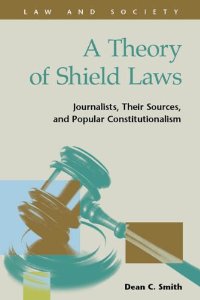
shield-lawsUNC Center for Media Law and Policy Research Fellow Dean Smith is the author of a new book, “A Theory of Shield Laws: Journalists, Their Sources, and Popular Constitutionalism,” published in June by LFB Scholarly Publishing.

In his book, Smith shows how the debate over confidential sources evolved over the 115-year history of statutory shield laws, and he examines how First Amendment values drove the debate in both the courts and in legislative bodies.  He corrects some long-standing errors in the historical record.

The book also is a textual analysis of enacted and proposed shield laws and cases that tracks the evolution in thinking on the journalist-privilege issue. Finally, it is a reappraisal of Branzburg v. Hayes that suggests a fresh way of seeing that familiar Supreme Court case: as neither a beginning nor an end, but as a midway point in a conversation the courts are having with the American people.

His use of the emerging concept of popular constitutionalism as a theoretical framework led Smith to new and important insights about this area of law, including the fact that legislative and judicial decision-making were intimately intertwined. Drawing on contemporary legal scholarship, Smith used the reporter’s privilege issue to test constitutional-law scholar Michael Gerhardt’s theory of “non-judicial precedents,” and he has shown how, true to the theory, people acting outside the courts help give meaning to constitutional principles such as freedom of the press over time.

Smith earned his Ph.D. from the UNC School of Journalism and Mass Communication in 2012.  He has presented award-winning papers at academic conferences and published in scholarly journals.  Smith also has written two white papers for the media law center.  The first paper summarized the findings of a center-sponsored conference on how to meet the information needs of communities. The second report described the benefits of state public affairs networks (SPAN systems) that cover state government.

Smith spent the past academic year teaching media law and newswriting at N.C. State University and High Point University. This fall he will begin work as an assistant professor at High Point University.

Before coming to UNC, Smith worked for The Charlotte Observer (1990-2004) and The (Raleigh) News & Observer (2004-2006) as a copy editor, reporter, and editor.

0